Find services, projects and certifications
Find services, projects and certifications
Find services, projects and certifications
Find services, projects and certifications
Emphasize risk mitigation and regulatory compliance. These descriptions reassure clients that hidden liabilities—such as hazardous materials or soil contamination—are identified and managed before they derail a project or lead to legal issues.
Our environmental inspection services provide a critical layer of protection for property owners, developers, and lenders. We conduct rigorous site assessments to identify potential environmental hazards, ensuring that your project complies with all local, state, and federal regulations while protecting the health of future occupants.
We perform comprehensive ASTM-standard Phase I ESAs to research historical land use and identify 'Recognized Environmental Conditions' (RECs). If contamination is suspected, our Phase II services include soil, groundwater, and vapor sampling to quantify the extent of the impact.
Prior to renovation or demolition, our certified inspectors conduct detailed surveys for asbestos-containing materials (ACM), lead-based paint, and PCBs. We provide clear inventory reports and abatement specifications to ensure hazardous substances are handled and disposed of safely.
We utilize advanced diagnostic tools to evaluate indoor environmental health. This includes moisture mapping, thermal imaging, and bio-aerosol sampling to identify mold growth or chemical off-gassing that could impact building occupancy.
Testing for radon gas infiltration to ensure safe indoor air quality and mitigate health risks.: focuses on preventative health and technical mitigation, framing radon testing as a critical component of modern building safety and liability management.
"As a colorless, odorless, and tasteless gas, radon represents a significant invisible risk to building occupants and long-term property value. Our environmental team provides specialized radon gas infiltration testing and mitigation design to ensure your project meets the highest standards for indoor air quality and occupant safety."
We deploy certified continuous radon monitors (CRMs) or charcoal canisters to accurately measure picocuries per liter (pCi/L) levels within the building’s lowest livable areas. Our testing protocols adhere to strict EPA and AARST standards, accounting for seasonal variations and building pressure fluctuations.
For new construction or existing structures with elevated levels, we conduct communication testing to determine the permeability of the soil beneath the slab. This data allows us to design a precisely engineered solution rather than a one-size-fits-all approach.
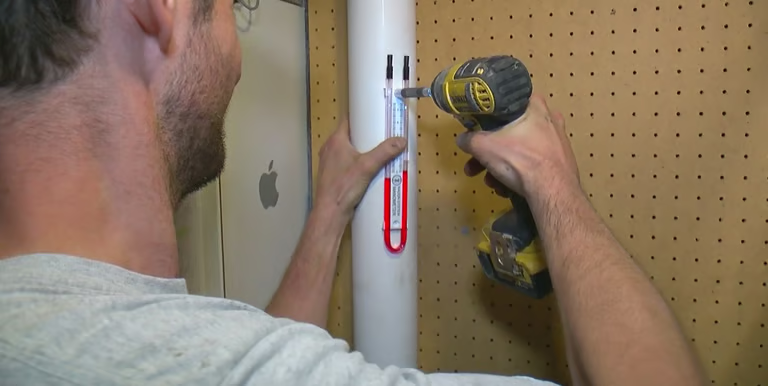
We design custom Active Soil Depressurization (ASD) systems. This involves the strategic placement of suction pits, high-efficiency inline fans, and exterior venting to draw radon gas from beneath the foundation and exhaust it safely away from the building before it can enter the breathing zone.
Our consultants coordinate with the mechanical team to ensure radon systems do not interfere with building pressure or HVAC balance. We specify gas-permeable layers and vapor retarders during the design phase to provide a passive defense against gas ingress.